
03 May 2026
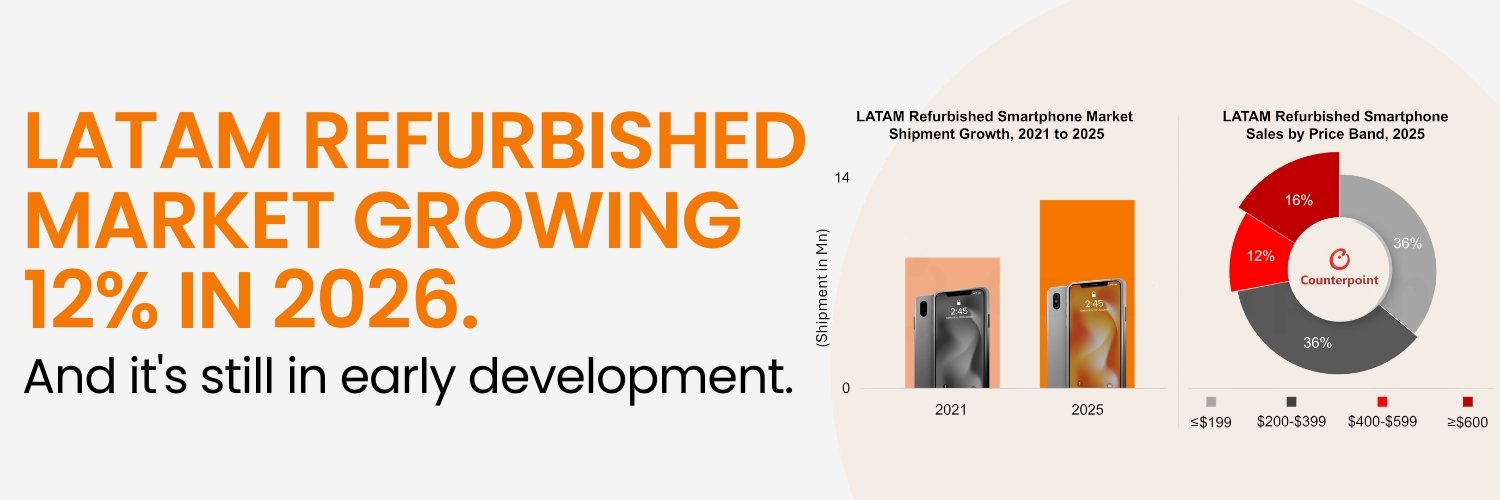
Latin America’s refurbished smartphone market is projected to grow 12% year-over-year in 2026, outpacing the global growth forecast of around 11%, according to Counterpoint Research’s Global Pre-Owned Smartphone Market Report, H2 2025. The market already accounts for over $4 billion in value and an 11% volume share of total smartphone sales in the region — and it is still in the early stages of its development.
The growth is being driven by a convergence of structural and cyclical forces: a gradual shift toward organized sales channels, rising new device prices fueled by the global memory shortage, strong price sensitivity among Latin American consumers, and Apple’s dominant and growing share of the secondary market.
For resellers and wholesalers looking to expand into or deepen their presence in LATAM, the timing is well-suited. At HK Refurbished Stock, we supply wholesale refurbished iPhones and refurbished Samsung phones to partners worldwide — including those serving Latin American markets. Here is what the data shows.
The Scale of the Opportunity: $4 Billion and Growing
The global pre-owned smartphone market reached $83 billion in revenue last year — representing 19% of total smartphone sales value for the third consecutive year. Within that, Latin America’s refurbished segment generated more than $4 billion in market value, with an 11% volume share of regional smartphone sales.
The region’s pre-owned market has grown 44% in volume from 2021 to 2025, reflecting a sustained multi-year shift in consumer behavior. The top five markets in LATAM — which together account for 72% of the region — have been the primary engines of this growth, alongside a 4% year-over-year decline in gray market activity as organized channels gain ground.
Despite this growth, LATAM’s refurbished market is described by Counterpoint Research as still developing — which means the structural gains ahead are likely larger than what has already been captured.
What Is Driving 12% Growth in 2026
1. The Shift Toward Organized Sales Channels
One of the most significant structural changes underway in LATAM is the migration from informal and gray market transactions toward organized retail and e-commerce channels. Retailers are broadening their refurbished smartphone portfolios across both physical stores and online platforms, and this increased availability is directly translating into greater consumer confidence.
The trend is also being reinforced by improvements in device grading, extended warranty periods, and certifications offered by market participants — all of which address the trust barriers that have historically limited refurbished adoption in the region. Carriers, however, remain largely absent from this channel: unlike more mature markets, LATAM carriers rely primarily on new device sales, leaving the secondary market ecosystem fragmented and dependent on non-carrier retail and e-commerce players.
2. The Global Memory Shortage Is Pricing Consumers Into the Secondary Market
The ongoing global shortage of DRAM and NAND memory components is pushing up the cost of new smartphones across the board, mirroring dynamics seen in more developed markets. As new device prices rise, the price gap between a new smartphone and a refurbished equivalent becomes an increasingly powerful driver of purchase decisions.
In LATAM, that gap typically falls between $50 and $200 — or roughly 30% to 50% off the price of a new device. For a region characterized by high price sensitivity, this differential is large enough to meaningfully shape consumer behavior. The memory shortage is also accelerating trade-in activity, further expanding the supply of refurbished devices available to the market.
3. Rising ASPs in the Refurbished Segment
LATAM recorded an increase in average selling prices (ASPs) for refurbished devices in the second half of 2025. This was partly driven by a weak upgrade response following the launches of the Samsung Galaxy S25 series and the Apple iPhone 17, which directed demand toward the premium refurbished segment — defined as devices priced above $600 — resulting in modest 1% year-over-year growth in that tier.
Rising ASPs in refurbished indicate that LATAM consumers are increasingly willing to pay more for quality pre-owned devices — a positive signal for resellers operating at the higher end of the secondary market.
Brand Dynamics: Apple Dominates, Samsung Underperforms Its Primary Market Share
Apple: 58% of the Global Refurbished Market
Apple holds a 58% share of the global refurbished smartphone market and leads the LATAM secondary segment as well. The driver is consistent: consumers seeking premium features at reduced prices gravitate toward iPhones, which offer a recognized brand, strong build quality, and long software support cycles. In LATAM, this dynamic is especially pronounced given the region’s price sensitivity — a refurbished iPhone at 30% to 50% off new pricing is a compelling proposition for aspirational buyers. For resellers, stocking wholesale refurbished iPhones is the clearest way to align inventory with where secondary market demand is concentrated.
Samsung and Motorola: Strong Primary Market Presence, Weaker Secondary Pull
Samsung and Motorola are the top two brands in LATAM’s primary smartphone market, but Counterpoint Research notes that both carry weaker buyer preference in the pre-owned segment, which limits their secondary market growth potential in the region. This is a meaningful divergence from global patterns, where Samsung refurbished demand is more robust. For resellers serving LATAM specifically, this suggests that refurbished Samsung inventory should be positioned carefully — with more emphasis on flagship models, where brand equity is stronger, than on mid-range or entry-level devices.
Chinese OEMs: Brand Value Still to Be Built
Xiaomi, realme, vivo, and HONOR — all significant players in LATAM’s primary market — have yet to establish strong brand value in the pre-owned segment. Building that recognition in the secondary market will take time and deliberate effort, and for now, these brands represent a limited opportunity for refurbished-focused resellers in the region.
The E-Commerce Infrastructure Driving Refurbished Sales
Online platforms are a primary growth channel for refurbished smartphones in LATAM. Mercado Libre — the Argentine company operating across 18 countries in the region — is the dominant platform. Alongside it, Reuse (Chilean, expanded across Latin America), Clevercel (operating in three of LATAM’s top five markets), and Trocafone (Argentina and Brazil) are driving refurbished volumes through dedicated e-commerce infrastructure.
Amazon is also present and growing. On the offline side, major regional retailers including Casas Bahia, Alkosto, Coppel, and Walmart are expanding their refurbished portfolios in physical stores — a signal that brick-and-mortar retail is no longer treating refurbished as a niche category.
For wholesale partners and resellers, this platform landscape matters: it defines the channels through which end consumers are discovering and purchasing refurbished devices, and shapes where resellers should be building their own distribution presence.
The Broader Ecosystem: iOS Migration and E-Waste
Counterpoint Research highlights two secondary dynamics worth noting for anyone operating in the LATAM refurbished space.
Platform migration: The secondary market contributes to increased migration between Android and iOS platforms, and iOS is identified as the main beneficiary of this churn. This reinforces Apple’s structural advantage in the refurbished segment: as consumers move from Android to iOS through the secondary market, demand for refurbished iPhones is self-reinforcing.
E-waste and circular economy: The development of e-waste management infrastructure — built on repair, reuse, and material recovery — is identified as a critical enabler of long-term market maturity in LATAM. As regulatory and consumer pressure around sustainability grows, the refurbished market’s role in the circular economy becomes both a competitive differentiator and a structural growth driver.
Key Takeaways
- LATAM’s refurbished smartphone market is projected to grow 12% YoY in 2026, outpacing the global growth forecast of ~11%.
- The market already exceeds $4 billion in value with an 11% volume share, having grown 44% in volume from 2021 to 2025.
- The global memory shortage is raising new device prices, accelerating trade-in activity and pushing consumers toward refurbished alternatives.
- Refurbished devices offer $50–$200 in savings vs. new, or 30%–50% off — a gap significant enough to shape purchase decisions in a price-sensitive region.
- Apple holds 58% of the global refurbished market and leads the LATAM secondary segment; Samsung and Motorola underperform their primary market share in pre-owned.
- Mercado Libre, Reuse, Clevercel, Trocafone, and Amazon are the primary e-commerce channels; offline retailers including Casas Bahia, Alkosto, and Walmart are expanding their refurbished portfolios.
- LATAM carriers are largely absent from trade-in channels, leaving the market fragmented — and open to organized wholesale and reseller partners.
Expand Into LATAM With the Right Refurbished Inventory
With LATAM’s refurbished market growing faster than the global average and Apple leading demand in the secondary segment, now is the right time to build out your inventory. HK Refurbished Stock supplies wholesale refurbished iPhones and refurbished Samsung phones to resellers and wholesale partners serving markets across Latin America and beyond.
Get in touch with our team to discuss stock availability, device grades, and wholesale pricing.